A Beginners Guide: Pour Over Brewing
Coffee Alcohol Recipes Blend
Main Contents
- A. Beginners Guide: Intro
- B. Coffee Grinding
- C. Ratio
- D. Water Quality
- E. Temperature
- F. Funnel: The Extraction
A. Beginners Guide: Intro
Craft coffee, particularly pour-over, is growing in popularity. It produces clear, light, and unusual flavors that are difficult to find in other brewing processes.
Difficulty?
Let us walk you through the stages to mastering the pour-over coffee brewing method.
B. Coffee Grinding
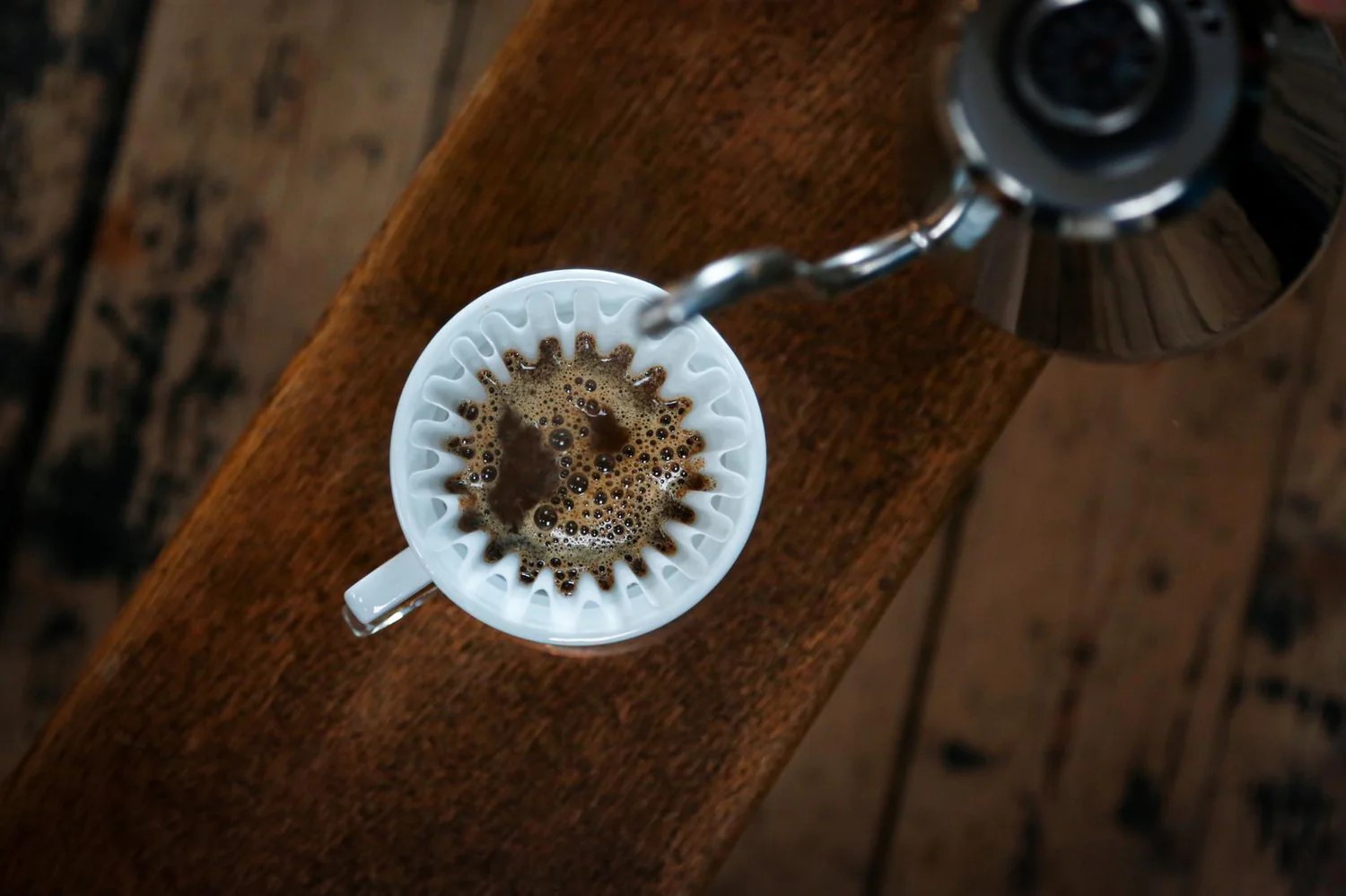
The grind size greatly determines the quality of the pour-over coffee cup. As a result, determining the grind size is crucial to brewing a satisfying cup of coffee. You can start by grinding your coffee to a medium-coarse grind (about the size of a sugar grain) and then adjust the grind size based on how robust or mild you want the flavor to be.
C. Ratio
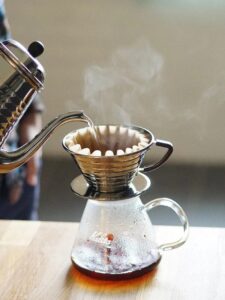
Pour-over coffee usually has a coffee/water ratio of 1:12 to 1:17, which means that for every gram of coffee, you’ll pour 12-17 grams of water.
Start with the recipe for a 1:15 version, which calls for 15 grams of coffee and 225 grams of water, and then tweak it to suit your tastes.

D. Water Quality
Water is another important aspect that influences the quality of the coffee cup. The ordinary tap water has contaminations, lowering the quality of brewed coffee. For the greatest coffee quality, we recommends using filtered water, distilled or mineral water.
E. Temperature
The extraction of taste in coffee is affected by the temperature of the water. High heat will help you extract more effectively, but it will also cause bitterness. On the other hand, low temperatures make it more difficult to extract the coffee, which might result in a sour, less sweet, and bland flavor.
To extract better tastes, use 90-96 degrees Celsius water for light roasted coffees and gradually lower the temperature for dark roasted coffees. Start with a temperature of 94°C for lightly roasted coffee, 88°C for medium roast coffee, and 80°C for dark roast coffee, then gradually increase the temperature to your preferred flavor.
The four basic components that influence coffee flavor are listed above. You have up to 80% of an excellent cup of coffee in your palm once you’ve mastered the following four variables.
How about the funnel? We’ll tell you more about it below.
F. Funnel: The Extraction
The flavor and the difficulty of use will be determined in part by the various funnel forms and the various funnel materials which will affect the quality of the coffee cup.
The funnel will absorb the heat energy of the brewed water if it is made of porcelain or metal, making the extracted coffee weaker.
If you’re going to use these items, make sure to preheat the funnel first.
We’ll tell you more about it below.
The V60: A Flexible Control
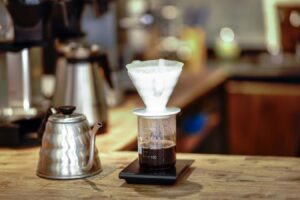
When it comes to pouring over coffee, this is the standard funnel. Water will penetrate the coffee more easily with a 60-degree slanting cone shape. The V60 requires more technique and being more difficult to uniform than other funnels type.
You receive richer, more tart flavors in return and richer meals.
With the V60, users will need to pay more attention to controlling the water flow, since pouring too much water causes the water to move through the coffee too quickly, resulting in poor extraction and vice versa.
If you utilize the V60, don’t forget to invest in a nice gooseneck kettle, as this will have a significant impact on your experience
A Beginners Guide: Pour Over Brewing
It’s time for you to brew some Specialty Coffee.
Try our coffees
Every month we sourced from different countries to select the best farm coffees harvest. We gently micro-batch drum roast all of our coffee beans in our roastery in Singapore. Indulge yourself in our flavorful coffees!
Taste To Believe.
Get your fresh roast coffee beans on-demand from us:
https://soji.coffee
-
![[THE AFRICA SAFARIS BLEND] ETHIOPIA TRIO (LIMITED NEW! 2026](https://soji.coffee/wp-content/uploads/2025/12/The-Blends-ARTWRK-ETHIOPIA-TRIO-1-500x500.jpg) [THE AFRICA SAFARIS BLEND] ETHIOPIA TRIO (LIMITED NEW! 2026SGD Price range: $48.90 through $92.90
[THE AFRICA SAFARIS BLEND] ETHIOPIA TRIO (LIMITED NEW! 2026SGD Price range: $48.90 through $92.90 -
![[THE CARIBBEAN PACIFIC BLEND] COLOMBIA DUO (LIMITED NEW! 2026)](https://soji.coffee/wp-content/uploads/2025/12/The-Blends-ARTWRK-COLOMBIA-DUO-1-500x500.jpg) [THE CARIBBEAN PACIFIC BLEND] COLOMBIA DUO (LIMITED NEW! 2026)SGD Price range: $41.90 through $79.90
[THE CARIBBEAN PACIFIC BLEND] COLOMBIA DUO (LIMITED NEW! 2026)SGD Price range: $41.90 through $79.90 -
![[THE CARIBBEAN PACIFIC BLEND] HONDURAS+BRAZIL (LIMITED NEW! 2026)](https://soji.coffee/wp-content/uploads/2025/12/The-Blends-ARTWRK-HONBRA-1-500x500.jpg) [THE CARIBBEAN PACIFIC BLEND] HONDURAS+BRAZIL (LIMITED NEW! 2026)SGD Price range: $39.90 through $74.90
[THE CARIBBEAN PACIFIC BLEND] HONDURAS+BRAZIL (LIMITED NEW! 2026)SGD Price range: $39.90 through $74.90 -
![[THE CARIBBEAN PACIFIC BLEND] NICARAGUA+BRAZIL (LIMITED NEW! 2026)](https://soji.coffee/wp-content/uploads/2025/12/The-Blends-ARTWRK-NICABRA-1-500x500.jpg) [THE CARIBBEAN PACIFIC BLEND] NICARAGUA+BRAZIL (LIMITED NEW! 2026)SGD Price range: $38.90 through $72.90
[THE CARIBBEAN PACIFIC BLEND] NICARAGUA+BRAZIL (LIMITED NEW! 2026)SGD Price range: $38.90 through $72.90 -
![[THE KNIGHTS BLEND] Ⅲ HORSEMENS (LIMITED NEW! 2026)](https://soji.coffee/wp-content/uploads/2025/12/The-Blends-ARTWRK-THE-KNIGHTS-1-500x500.jpg) [THE KNIGHTS BLEND] Ⅲ HORSEMENS (LIMITED NEW! 2026)SGD Price range: $36.90 through $69.90
[THE KNIGHTS BLEND] Ⅲ HORSEMENS (LIMITED NEW! 2026)SGD Price range: $36.90 through $69.90 -
 BRAZIL SANTA MARIA CERRADO (Espresso)SGD Price range: $12.50 through $49.90
 -
 BRAZIL SUL DE MINAS (Espresso)SGD Price range: $12.50 through $49.90
 -
 COLOMBIA CAUCA CONDOR (Espresso)SGD Price range: $14.90 through $65.90